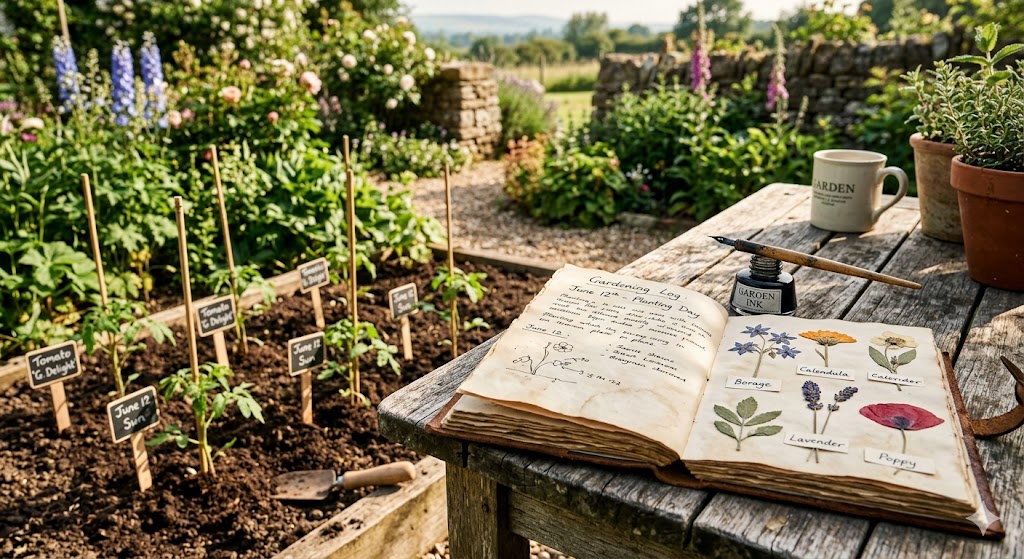
Every experienced gardener will tell you the same thing: keep a journal. Not because it's trendy or aesthetic (though it can be both) — but because memory is unreliable and gardening is all about patterns that repeat over years. Your journal is the repository of what actually happened, what worked, and what failed, in your specific garden, in your specific climate, with your specific soil. Nothing replaces that.
What to Record in Your Garden Journal
The most useful records: planting dates (what you planted, when, and where), seed varieties and sources, germination dates and rates, transplant dates, first harvest dates, last harvest dates, pest and disease observations (what appeared, when, how severe), weather events (late frosts, heat waves, drought periods), and what you would do differently next time. Secondary useful records: fertilizer applications, soil amendments, irrigation issues, crop rotation plans, photos of plants at key stages, and sketch maps of your beds showing what grew where each season. Don't try to record everything at once — even capturing 5 key data points per crop is enormously valuable over time.
Formats: Paper Notebooks, Apps, or Spreadsheets
Paper journals have no battery problems, are pleasant to use, and can hold pressed flowers, seed packets, and sticky notes. A simple spiral notebook or a dedicated gardening journal works fine. Apps like Planter, Garden Manage, and Growstuff offer digital tracking with reminders, variety databases, and cloud backup. Spreadsheets (Google Sheets, Excel) are flexible and searchable — create columns for what you want to track and add rows as the season progresses. The best format is the one you'll actually use consistently. Some gardeners prefer a hybrid — rough notes in a pocket notebook during the season, then transcribed to a spreadsheet in winter for easier searching and comparison.
Using a Journal to Track First and Last Frost Dates
Your local weather service provides average frost dates, but your specific location can vary significantly from regional averages. Urban heat island effects, cold air drainage into valleys, and local topography all affect frost timing. Recording actual first and last frost dates in your specific garden over several years gives you the most accurate planting calendar available. You may discover your garden consistently frosts 2 weeks earlier than the regional average in fall — information that changes every planting and harvesting decision. Track these dates every year and the pattern emerges over 3 to 5 seasons.
Variety Notes: The Most Valuable Long-Term Records
Commercial seed company photos and descriptions are marketing materials. Your own notes about how a variety performed in your garden are truth. Record: variety name, seed source, days from planting to harvest (versus the listed days), flavor, yield, disease issues, whether you'd grow it again. Over years, you build a personalized variety database that guides every seed purchase. You'll discover that certain tomato varieties always underperform in your humid climate while others thrive, certain lettuce varieties bolt faster than others in your heat, and certain bean varieties consistently produce in your soil. This knowledge is irreplaceable.
Tracking Pests and Diseases
Pest pressure is often predictable by date. If you note that aphids always appear on broccoli in your garden in mid-April, you can intervene before damage occurs rather than reacting after infestation. Similarly, noting when flea beetles arrive on eggplant, when squash vine borer moths typically fly, and when late blight conditions develop lets you time preventive measures. A brief weekly observation log — even just a few lines — builds this pattern recognition over seasons. Combined with crop rotation records, pest and disease tracking is one of the most powerful ways to reduce problems before they become crises.
Winter Review: Mining Your Journal for Insights
The winter review is where the journal pays dividends. Sit with a cup of tea and your journal in January or February — before seed orders begin — and review the past season. What failed? What worked better than expected? Which varieties are you ordering again and which are you replacing? What pest or disease recurred that you need to plan around? What timing changes would improve results? Develop next season's planting calendar based on actual observations from your journal, not just seed packet recommendations. This review transforms the journal from a record into an active planning tool that improves every subsequent season.
Frequently Asked Questions
How much time does keeping a garden journal take?
A practical journal takes 5 to 10 minutes per week for basic recording. A detailed journal might take 20 to 30 minutes per week during peak season. Even minimal recording is far better than none.
What is the most important thing to record in a garden journal?
Planting dates and harvest dates — these two data points alone dramatically improve planning accuracy. If you capture nothing else, capture when you planted and when you first harvested each crop.
Are garden journal apps worth using?
For gardeners who prefer digital tools, yes. Apps with reminder features are especially useful for time-sensitive tasks like succession planting and pest monitoring. The best app is whichever you'll use consistently.
Should I include photos in my garden journal?
Absolutely. A photo of disease symptoms, pest damage, crop layout, or exceptional harvests is often more informative than written description. Timestamp photos with the journal entry date for context.
Can kids keep their own garden journals?
Yes — children's garden journals are an excellent educational tool. Simple entries (date, what I planted, what I noticed) build observation skills, scientific thinking, and long-term engagement with gardening.
The best gardeners are not the ones who know the most — they're the ones who observe the most carefully and remember what they learned. A garden journal is how you make your observations permanent and your learning cumulative.