Almost everyone has started a journal at some point. And almost everyone has a partially filled notebook buried in a drawer somewhere. The intention is genuine. The follow-through breaks down. Not because you're undisciplined, but because most journaling advice sets you up for failure: too much structure, too many rules, too high a standard to meet before you've even begun.
This guide is different. It's about building a journaling practice that fits your actual life — not a perfect version of your life — and sticking with it long enough to experience the real benefits.
Why Journaling Is Worth the Effort
The benefits of regular journaling are well-documented and cover a wide range: reduced stress and anxiety, improved emotional clarity, better decision-making, stronger self-awareness, enhanced creativity, and even measurable improvements in physical health. Research by James Pennebaker (University of Texas) showed that writing about emotional experiences for just 15–20 minutes per day over several days produced improvements in immune function, fewer doctor visits, and better psychological adjustment.
You don't need to do it perfectly. You need to do it consistently. Those are very different goals.
Choose the Right Format First
The best journaling format is the one you'll actually use. The options:
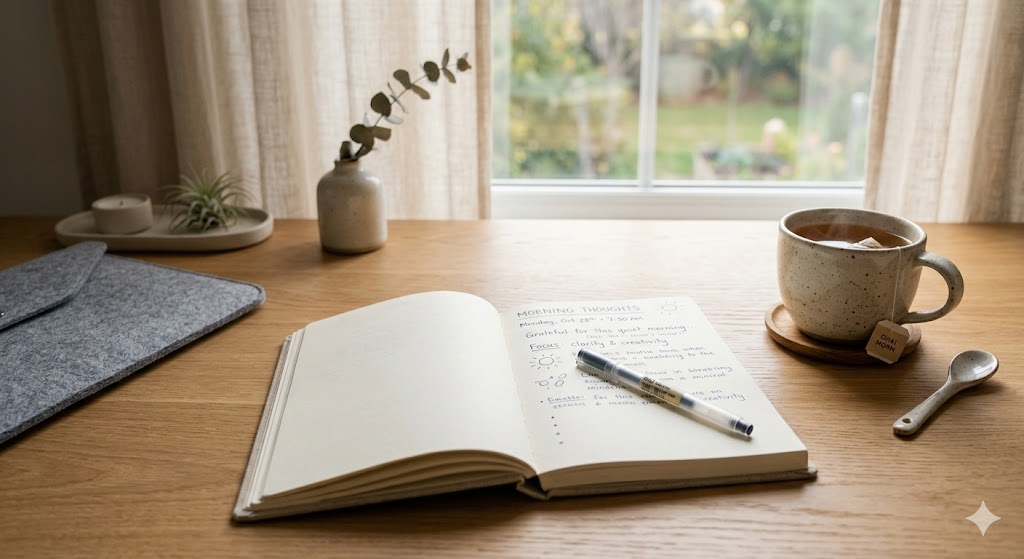
Physical notebook: The most popular choice and for good reason. Writing by hand slows you down in a good way — it allows more processing and tends to create a stronger connection to the material. Choose a notebook that feels good to touch and write in. The pen matters too. Creating a pleasant physical experience lowers the activation energy to begin.
Digital app: Great for convenience and searchability. Apps like Day One, Notion, or even a simple phone notes app work well. If you're on your phone constantly, this removes a friction point. The downside: the same device holds every distraction.
Voice journaling: Speak your journal entry into a voice memo or transcription app. Excellent if you think more fluently out loud than on paper. Some people find it more emotionally expressive. Less searchable and reviewable, but a legitimate and effective format.
Pick one. Don't agonize. You can always switch later.
The One Rule That Makes Journals Stick
Never make an entry feel like a test. There is no correct way to journal. Grammar, coherence, eloquence — irrelevant. Your journal is purely for you. Write fragments. Draw. Write in lists. Write angry, confused, circular thoughts. Whatever comes out is the right thing.
The moment journaling starts to feel like homework or performance, it dies. The one rule: be honest. With that, everything else is optional.
A Simple System for Beginners: The 3-Minute Journal
If the blank page feels paralyzing, start with structure. The 3-minute journal uses three simple prompts that take about one minute each:
- Morning: “What am I grateful for today?” (one to three specific things). “What would make today successful?” (one concrete answer).
- Evening: “What went well today?” (one to three things). “What would I do differently?”
That's it. Three to five minutes total. Do this for 21 days. By the end, you'll have established the habit and discovered whether you want to go deeper — most people do.
Six Beginner Journaling Prompts to Get You Started
- How am I actually feeling right now? (Not “fine” — go deeper.)
- What has been taking up the most space in my mind this week?
- What am I looking forward to, even slightly?
- What is one thing I appreciate about my life that I don't always notice?
- What is something I've been avoiding that I know I should address?
- If I could change one thing about my life right now, what would it be?
You don't need to answer fully. You don't need to write in complete sentences. Write whatever comes. The prompt is a door — it doesn't matter if you walk through it straight or sideways.
When and How Often to Journal
Consistency matters more than frequency. A five-minute daily practice beats a one-hour weekly session for building self-awareness and emotional processing. Pair journaling with an existing ritual — morning coffee, evening wind-down, commute if you travel by transit. Attaching the new habit to an existing one is the single most effective thing you can do to make it automatic.
If you miss a day, don't make up for it. Just write again the next day. Missing one entry means nothing. Quitting because you missed one means everything. The practice is the commitment to return, not perfect attendance.
When Your Journal Runs Out
This is where most people make a mistake. They finish a notebook, don't have another ready, and the habit evaporates in the gap. Have your next journal waiting before the current one ends. This single logistical detail has saved more journaling practices than any motivational tip.
Frequently Asked Questions
What should I write in a journal if I don't know where to start?
Start with “I don't know what to write.” Then keep writing. Describe your physical environment. Note how you're feeling. Answer: “What's on my mind right now?” The resistance to starting is the main obstacle. Once you're writing — anything — the content usually follows. Prompts (like the six above) are also an excellent starting point for anyone who finds the blank page intimidating.
Should a beginner journal every day?
Daily journaling builds the most reliable habit because of its regularity. However, if daily feels like too much commitment, three to four times per week is a perfectly valid starting point. What matters most is that you show up consistently rather than intensively. A two-minute entry four days a week is infinitely more valuable than a two-hour entry once a month.
Should I re-read old journal entries?
Yes — and this is one of journaling's most underrated benefits. Reading entries from three, six, or twelve months ago reveals patterns in your thinking, shows you how much you've grown, and often proves that the things you were worried about either didn't happen or were survivable. A monthly review of the previous month's entries takes 10 minutes and provides compounding insight over time.
Is journaling private? Do I need to worry about someone reading it?
Your journal is as private as you make it. For the practice to produce its full benefits, you need to write honestly — which requires confidence that no one will read it without your permission. If privacy is a concern, store your journal somewhere secure, use a journaling app with password protection, or tear out and discard entries that feel too sensitive to keep. Write freely first, worry about privacy second.