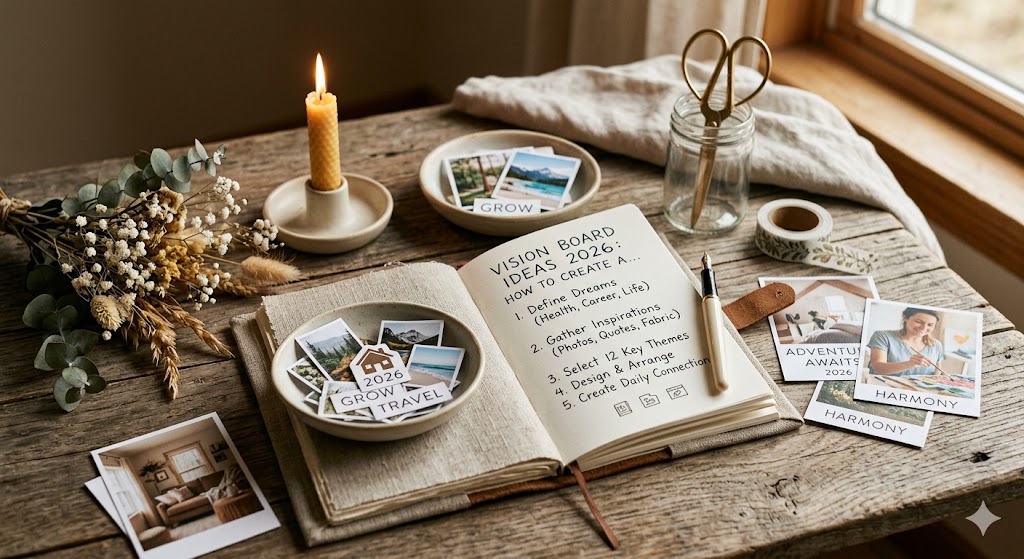
Vision boards have been around long enough to accumulate both devoted fans and tired skeptics. The skepticism is fair — a collage of magazine cutouts won't make your dreams materialize on its own. But dismissing vision boards entirely misses what they can genuinely do when built and used thoughtfully.
Last updated: April 2026
- Vision boards work best when combined with daily visualization and action, not as passive decoration.
- Clarity about how you want to feel and who you're becoming matters far more than aesthetic perfection.
- Multiple life categories (career, health, relationships, growth, finances, experiences, mindset) create more powerful outcomes than single-focus boards.
- The daily practice of sitting with your board and asking “What's one thing I could do today?” converts visualization into tangible results.
- Both digital and physical formats work equally well — choose based on what you'll actually engage with consistently.
A well-made vision board serves as a daily visual anchor for your intentions, a clarifying exercise in identifying what you actually want (versus what you think you should want), and a subtle source of motivational momentum. According to Barbara Fredrickson's broaden-and-build theory, positive emotions cultivated through daily practices like visualization don't just feel good in the moment — they help build lasting psychological and social resources over time (Fredrickson, 2001, American Psychologist). The key is building one that reflects genuine clarity rather than borrowed aspirations.
Here's how to build a 2026 vision board that goes beyond pretty pictures — and actually works.
Why Should You Start With Clarity Before Building Your Vision Board?
You should start with clarity because the foundational work that makes a vision board powerful happens before you touch a single image — identifying how you genuinely want to feel and who you're becoming determines whether your board will actually motivate action. Most vision board advice skips this critical step and goes straight to cutting out images, missing the foundational clarity that determines whether your board actually works.
Spend 20–30 minutes journaling on these questions first:
- How do I want to feel in 2026? (Not what I want to have — how I want to feel)
- What areas of my life feel most ready for growth or change?
- What would a genuinely good year look like for me — specifically?
- What am I building toward that's beyond just this year?
- What do I want to be different about my daily experience of life?
Capture the words and phrases that emerge. These become the emotional and intentional anchors for everything you'll select for your board.
What Categories Should Your 2026 Vision Board Include?
Your 2026 vision board should include multiple life dimensions — career, health, relationships, personal growth, finances, experiences, and mindset — because boards that span all the areas that matter to you create a holistic picture of growth rather than a single-focus collage. The most effective vision boards cover multiple dimensions of life rather than focusing only on career or material goals. Here are categories to consider, with specific ideas for each:
Career and Creative Work — Best for: professionals building toward a specific role, income milestone, or creative project
- Images representing the type of work environment you want (remote, studio, outdoors)
- Symbols of specific projects or creative goals you're pursuing
- Words like “recognized,” “impactful,” “building,” “creating”
- A visual of the income milestone you're working toward (a number written boldly)
Health and Vitality — Best for: anyone building consistent movement, rest, or nourishment habits
- Images of movement and activities you want to do consistently — not just “fitness” generically
- Food and nourishment imagery that represents how you want to fuel yourself
- Rest and restoration images — peaceful sleep, nature, stillness
- Energy words: “strong,” “rested,” “alive,” “present”
Relationships and Connection — Best for: those prioritizing deeper community, friendship, or partnership in 2026
- Images representing the quality of connection you want — laughter, depth, ease
- Symbols of community (if that's a focus area for you)
- Words like “supported,” “belonging,” “authentic,” “reciprocal”
Personal Growth and Learning — Best for: people committed to skill-building, education, or identity evolution
- Book covers, courses, or subjects you want to study
- Images of skills you're developing
- Words representing who you're becoming: “curious,” “capable,” “evolving”
Financial and Material Goals — Best for: those with specific savings, income, or financial independence targets
- Specific numbers written clearly (savings goals, income goals)
- Images of experiences money will enable (travel, education, freedom)
- Symbols of security and stability
Experiences and Adventure — Best for: travel-focused planners or anyone centering experiences over acquisitions in their year
- Places you want to visit in 2026 — specific photos or maps
- Activities and events you want to experience
- Images of leisure and joy, not just achievement
Mindset and Inner Life — Best for: anyone focused on emotional baseline, self-concept, and inner peace
- Words representing the inner qualities you're cultivating: “peace,” “trust,” “open”
- Images that evoke the emotional state you want as your baseline
- Affirmations that feel personally resonant written in your own handwriting
Digital vs. Physical: Which Type of Vision Board Works Better?
Both digital and physical vision boards work equally well — the best format is whichever one you'll actually look at and engage with every single day. Here's how they compare:
| Format | Best For | Key Advantages | Limitations |
|---|---|---|---|
| Physical Board (poster board, corkboard, foam core) | Tactile learners who benefit from the meditative creation process; anyone who wants a visible daily wall reminder | Tactile and satisfying to make; lives on your wall where you see it automatically; the cutting and arranging process is itself clarifying | Not portable; harder to update; requires storage space |
| Digital Board (Canva — best for clean, polished aesthetics and fast collaging; Pinterest — best for discovering and organizing broad visual inspiration; image folder; dedicated vision board app — best for goal-tracking integration) | People who want mobile accessibility; those who prefer a polished, clean aesthetic; anyone who wants to update frequently | Always accessible on your phone; easy to update; can be set as wallpaper or screensaver; no storage needed | Less tactile; easier to ignore if not intentionally set as a phone reminder |
| Journal Vision Board (hybrid approach in a dedicated journal spread) | People who journal regularly; those who want something more personal and portable than a standard board | Combines images, handwritten intentions, and affirmations in one place; highly personal; easily portable | Less visible as a daily reminder; requires active journal review |
What Is the One Practice That Makes Vision Boards Actually Work?
Daily visualization combined with intentional action is what converts a vision board from decoration into results — the board itself is just the visual trigger; your active engagement with it is the engine. Research at UCLA found that process visualization — mentally simulating the specific steps you'll take to reach your goals, rather than just picturing the end result — activates planning, anticipation, and follow-through far more effectively than outcome-only imagination (Taylor et al., 1998, American Psychologist).
According to a 2021 meta-analysis of nearly 16,000 participants, the most effective visualization strategy combines imagining your goal with honest acknowledgment of real obstacles — a four-step method called WOOP (Wish, Outcome, Obstacle, Plan), developed by psychologist Gabriele Oettingen — and was associated with significantly better goal attainment than pure positive fantasy alone (Wang, Wang, & Gai, 2021, Frontiers in Psychology). This reinforces a core truth about vision boards: passive admiration produces modest results; engaged, obstacle-aware visualization produces meaningful ones.
Here's what most vision board content leaves out: visualization is the engine, but the board is just the ignition.
The practice that makes vision boards effective is spending time daily actually feeling what it would be like to live the vision on your board. Not just glancing at it — consciously pausing, looking at something specific, and inhabiting the emotional state of having it.
Try this: each morning, sit with your vision board for 2–3 minutes. Pick one image or intention. Close your eyes and imagine it's real — vividly, sensorially, emotionally. Feel the feelings. Then ask yourself how you can writing affirmations that match your board to support this vision in your daily life.
That final question is what converts visualization into action — which is ultimately where the results come from.
What Affirmations Should You Add to Your 2026 Vision Board?
The most effective vision board affirmations are handwritten, personally believable statements that connect to where you actually are right now — not aspirational claims that feel wildly disconnected from your current reality. Research in Psychological Science found that positive self-statements are most effective when they align with your current self-concept rather than contradicting how you see yourself (Wood, Perunovic, & Lee, 2009, Psychological Science). Self-affirmations — written statements that reflect your core values and the person you are becoming — work by activating a broader sense of self-worth not tied to any single setback or threat; a comprehensive review in the Annual Review of Psychology found that such exercises can produce positive psychological effects that last well beyond the moment of writing (Cohen & Sherman, 2014, Annual Review of Psychology).
Consider adding your own handwritten affirmations directly to your board:
- 2026 is a year of growth, joy, and meaningful progress.
- I attract the experiences, people, and opportunities that align with my vision.
- Every day I take small steps toward the life on this board.
- I deserve everything on this board — and more.
- My vision is clear, my commitment is strong, and I trust the journey.
- I am becoming the person this vision requires.
Frequently Asked Questions
Do vision boards really work?
Yes, when combined with active daily engagement and goal-directed action. The research on mental simulation and visualization shows that actively engaging with your vision produces measurable improvements in motivation and follow-through. According to a randomized study by Seligman and colleagues, specific positive psychology practices — including daily reflection on good experiences and why they occurred — were associated with lasting improvements in well-being at 1-month, 3-month, and 6-month follow-ups (Seligman et al., 2005, American Psychologist). Whether a vision board “works” depends almost entirely on how actively you engage with it — passive decoration produces modest results; daily intention-setting combined with the question “What's one thing I could do today?” produces meaningful ones.
How specific should my vision board be?
Be very specific about how things feel and who you're becoming, but balanced with openness about the exact form. For example: be specific about “I want to feel financially secure and free” rather than “I want this specific car.” The more you're attached to one narrow outcome, the more you might miss other pathways to the same feeling. Be clear about the destination, flexible about the route.
Should I show my vision board to other people?
This depends on your personality and how you respond to sharing goals. Research on goal-sharing has mixed findings. Some people find accountability and sharing motivating; others find that talking about goals prematurely creates a sense of having already achieved them, reducing motivation to act. If you're someone who tends to lose steam after telling people your plans, keep your board private. If sharing creates useful accountability, find a trusted person to share it with.
How often should I update my vision board?
Review it seasonally and update it whenever something no longer resonates — your vision will naturally evolve as you grow and circumstances change. Annual boards are the most common, but some people prefer living boards that shift throughout the year. The important thing is that what's on the board continues to feel genuinely meaningful rather than outdated.
How long does it take for vision board practice to become a habit?
A research study tracking real habit formation found that it takes an average of 66 days for a new behavior to reach automaticity, with a range of 18 to 254 days depending on the person (Lally et al., 2010, European Journal of Social Psychology). So if you're just starting your daily vision board practice, expect it to feel deliberate for roughly 2 months before it becomes an automatic part of your morning routine.